

If you’ve ever tried to sleep in a hot bedroom during a London or Surrey heatwave, you’ll know how uncomfortable it can be.
Loft conversions, top-floor flats, and south-facing bedrooms can easily reach 26–30°C at night, making proper sleep almost impossible.
While fans and air coolers provide some relief, they don’t actually lower the room temperature. Air conditioning does.
This guide explains why air conditioning is the best solution for bedrooms, what to expect, and how to choose the right system.
Bedrooms often trap heat more than other rooms in the home.
Common reasons include:
Heat rising to upper floors
Roof exposure in loft conversions
Poor night-time airflow
Modern insulation trapping heat indoors
Sun exposure throughout the day
This is especially common in:
London apartments
Surrey new-build homes
Loft bedrooms
Terraced houses
Once heat builds up, it stays there overnight.
Fans and air coolers don’t actually cool the room.
They simply move air around.
This means:
The room temperature stays the same
Heat remains trapped indoors
Relief is temporary
Air conditioning removes heat entirely, creating a genuinely cool environment.
Typical hot bedroom temperature: 27°C
| Cooling method | Result |
|---|---|
| Fan | Still 27°C |
| Air cooler | Around 24–26°C |
| Air conditioning | 16–20°C (fully controlled) |
This is the difference between discomfort and proper sleep.
Many homeowners worry air conditioning will be noisy.
Modern systems are designed specifically for bedrooms.
Typical indoor unit noise levels:
Quiet mode: ~19 dB
Normal operation: 20–30 dB
For comparison:
Whisper: 30 dB
Fan: 40–60 dB
Air conditioning is often quieter than a standard fan.
Most bedroom systems include:
A small indoor wall unit
A discreet outdoor unit
Hidden pipework
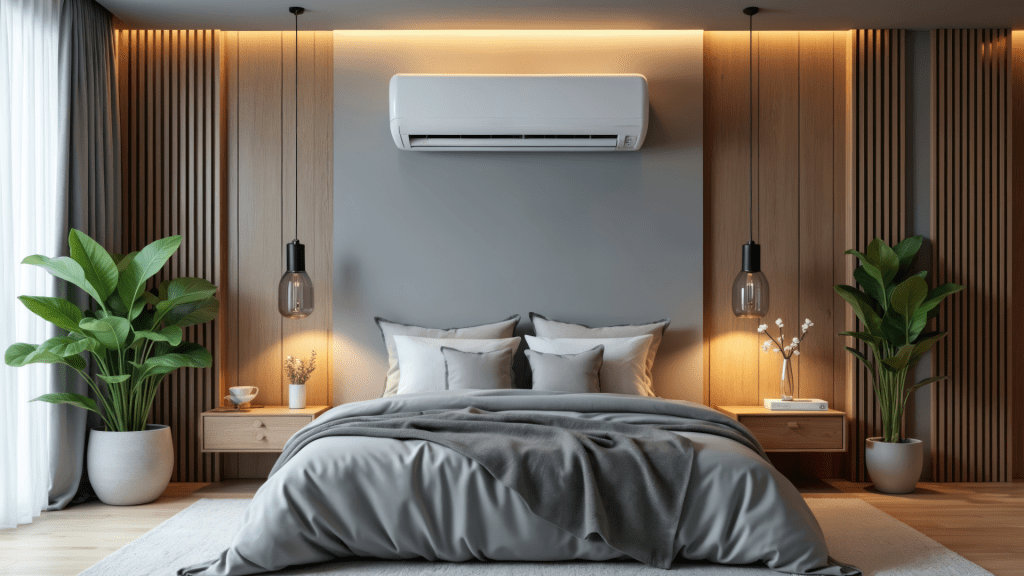
The indoor unit is typically placed high on the wall and blends with modern interiors.
Installation is usually completed within one day.
Bedroom air conditioning is highly efficient.
Typical usage:
Used primarily at night
Runs at lower power once temperature is reached
Maintains temperature automatically
Modern inverter systems adjust output to minimise energy use.
Air conditioning provides additional benefits beyond temperature control.
These include:
Improved air quality
Reduced humidity
Less dust and allergens
Better overall comfort
This is particularly valuable in urban areas like London.
The most effective setup for bedrooms is a wall-mounted split system.
This provides:
Quiet operation
Strong cooling performance
High efficiency
Long lifespan
Minimal visual impact
Portable units are less effective, noisier, and less efficient.
These are typically the hottest rooms in the home.
Air conditioning makes them fully usable year-round.
Heat rises and accumulates on upper floors.
Air conditioning provides reliable overnight cooling.
These absorb heat throughout the day.
Air conditioning removes trapped heat quickly.
No. Modern units are extremely quiet and often quieter than fans.
Most systems cool a bedroom within minutes and maintain temperature automatically.
Yes. Fans move air, but air conditioning removes heat and provides real cooling.
Yes. Most bedrooms in houses and flats across London and Surrey are suitable for installation.
Share this post:


